22 August 2026 · 5 min read
What Rehan Allahwala Taught Me About AI, Ethics, and Unlearning
A guest lecture in the GKMBA program turned my assumptions about experience upside down. Rehan Allahwala's argument is simple: skills depreciate faster than ever, but ethics, judgment, and human responsibility do not. This post works through the unlearn-to-relearn method he shared — and why AI can replace what we know, but not what we owe to each other.
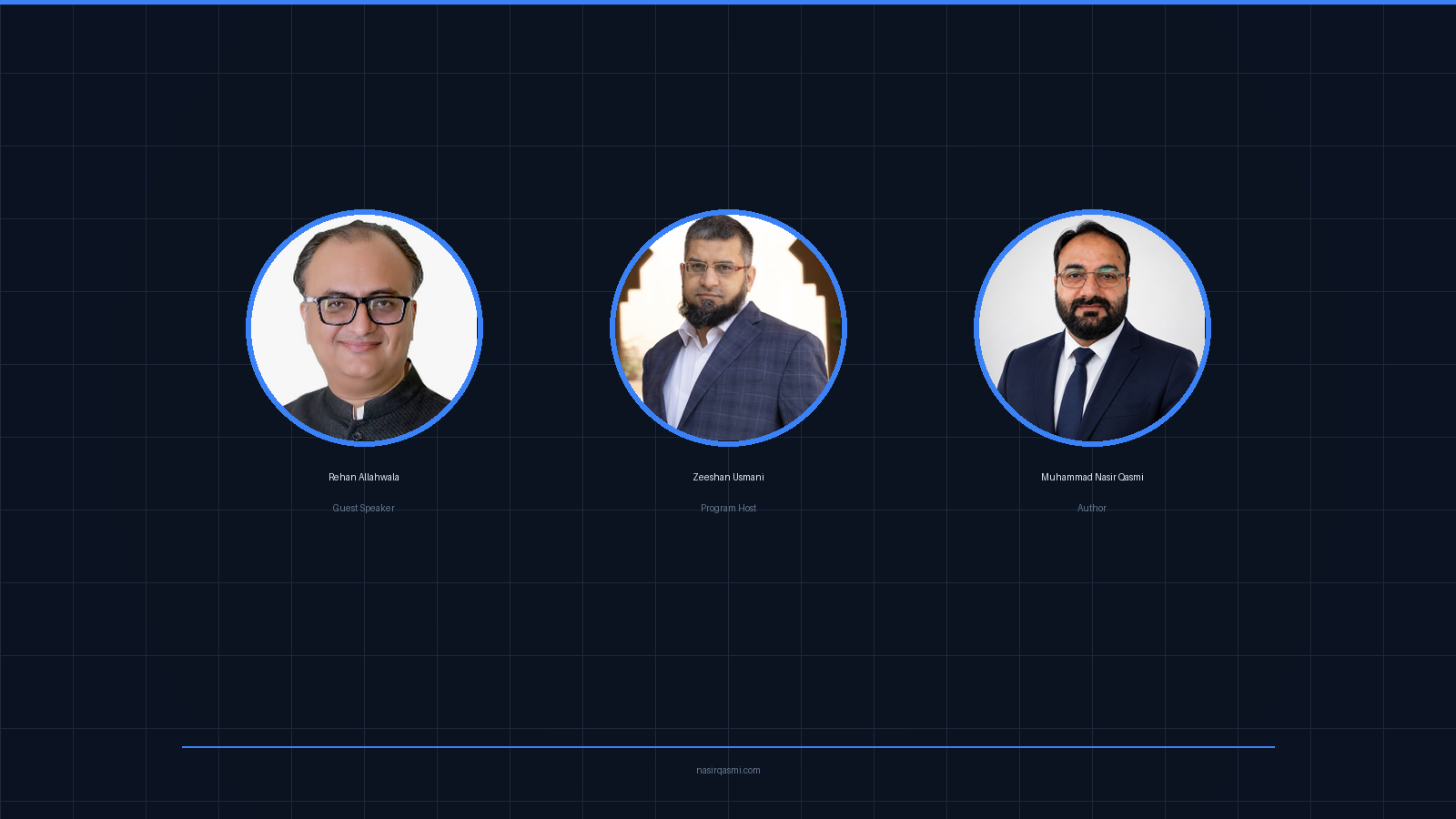
I sat in Rehan Allahwala's guest lecture in the #GKMBA program run by Zeeshan Usmani expecting a business talk. I came out with one sentence stuck in my head, and it was not about business at all.
AI can replace our skills. AI cannot replace our ethics.
He did not say those exact words. He said something that led straight to them, and it took me the rest of the evening to work out why it landed so hard.
The claim
The line that cuts against everything I was taught at home and in school: unlearn what you learned, then relearn it.
I was raised on the opposite. Learn a trade, get good, and the goodness compounds. Experience was supposed to be an asset that only appreciates. He is saying it is closer to a rented asset. You keep it only while you keep paying, and the rent went up the day AI arrived.
For someone with 15+ years in document control and information management on mega-projects, that is not a comfortable sentence. My instinct is to defend the vault. His instruction is to open it and check what is still worth keeping.
The method
Strip out the stories and the mechanism underneath is simple enough to write as steps.
- Make yourself AI-enabled. Not "aware of AI" — enabled. It goes into your daily working method or it does not count.
- Use the tools, including the new ones. Vibe-coding tools, productivity tools. His framing was speed: the wind speed increases, so the same effort now carries you much further.
- Learn to converse with AI, not consume it. He kept coming back to discussion — guftagu karna seekho. The skill is not prompting. It is holding an argument with a machine until something useful falls out.
- Always ask for both sides. AI is biased and it is built to please you. If you only ask one question, you get the answer that flatters your assumption. Ask it to argue against you.
- Build the network before you need it. He treats networking as the job itself, not as something you do while job hunting. Trust-based work comes through people, not portals.
- Then go wide, and go abroad. His advice to this cohort was blunt: if you can afford this program, the local market may not have a role at your level. Apply outside. And apply at volume — his number was 100 to 500 applications for one offer.
- Widen the circle deliberately. Make foreign friends. Learn other people's ethics, not only your own. He gave friendship the weight most people reserve for strategy.
The proof, and where you are simply asked to trust
What is checkable: a first company at 13. 150+ ventures across several countries. A school where children learn what he himself is learning, and where the point is that they earn while they are still students. He gives away most of what he knows for free, which is itself evidence — the model only works if the knowledge is real.
What rests on trust: the "apply to 100-500 and one will land" figure. That is a rule of thumb from his own market and his own reach, not a measured conversion rate. It might be true for a 22-year-old with a laptop. It is not a law.
I would rather name that honestly than pretend every number in a good talk is data.
The cost
150 businesses means mostly failures, and he says so in public, which is the rare part. Most people with that record edit it down to the three that worked.
He was clear that the lesson is priced in losses. You cannot buy it, you cannot be taught it, and no course transfers it. He paid in money, years, and reputation for a set of instincts he can describe to us but cannot install in us. That is the honest limit of any lecture, including this one.
Where the ethics thread lands
Here is why his talk pointed me at ethics rather than at tools.
He warned that AI is biased and tries to agree with you. That warning is the whole argument in miniature. A model optimises an answer. A human owns the consequence. The moment the output touches a real project, a real budget, a real person's safety, someone has to carry it — and no system carries anything.
He closed on things that do not automate: be grateful, be useful to people, keep your faith, look after your health because you will need it later, meditate, and tend your network. And the sentence that ties it together — every skill can become obsolete, but the ethic of friendship cannot.
That is where my five ethical skill sets sit, and the lecture gave them a spine they did not have before.
- Moral reasoning and decision-making. A model can rank options. It cannot decide which cost is acceptable and which is not. Judgment is not a training set.
- Integrity and accountability. Machines optimise outputs. Humans own outcomes. When a handover dataset is wrong, no one asks the model to explain itself.
- Social responsibility and inclusion. AI finds patterns, including the unfair ones it inherited. Choosing fairness is a decision, and decisions need a decider.
- Data and digital ethics. In information management this is my daily work. The steward of the data is a person. Access, retention, confidentiality — a system enforces rules, it does not choose them.
- Professional and compliance ethics. Governance needs an accountable name at the bottom of the page. A black box cannot sign.
What I disagreed with
The 100-500 applications advice contradicts his own stronger point.
If networking is the real channel — and he argued that convincingly — then mass applications are the weakest tool on the table for anyone senior. In EPC and information management leadership, one warm introduction outperforms three hundred cold applications, and I have watched that happen more than once. Volume is entry-level advice. It is not wrong, it is just aimed at a different person.
I say that with respect, and because he asked us to argue rather than nod.
My one action this week
Starting Monday, I am running every significant decision through AI twice: once for the recommendation, once for the strongest possible case against it. Then I decide. Thirty days, on live work, not practice questions.
Because if the machine is built to agree with me, the discipline of forcing it to disagree is the closest thing I have to an ethical safeguard.
---
Your turn: which of your skills do you think AI takes first — and which part of your judgment do you think it never touches?
Need this solved on your project?
Book a working session on document control, data governance or information handover.
Book a session